Wednesday, April 13, 2016

City of giants

Ever since the Phoenicians worshipped the sky god of Baal here in 2000 B.C., Heliopolis, or the City of the Sun, has occupied an important position along the caravan route that transects the Bekaa Valley north to south.

The propylaea (entrance). Replica of the original stairs was added by Kaiser Wilhelm II in the 1890s.
Stepping off the minibus ($8 admission fee), I share the astonishment experienced by travelers throughout antiquity — and more recently. "Such grandeur of design, and such grace of execution, as one sees in the temples of Baalbec [sic], have not been equalled or even approached in any work of men’s hands that has been built within twenty centuries past," wrote Mark Twain in his 1869 book "The Innocents Abroad." 


Baalbek in the 1880s. Photo from U.S. Library of Congress


That seems to be a common sentiment. "I can't believe I'm here" was what I heard from the English, Australian Danish and German visitors I met. We were all struck by the dimensions of Baalbek's stones, the height of the columns, the richness of the inscriptions. Bonding quickly, we took turns taking one another's pictures. With a new threat issuing from the other side of the Anti-Lebanon mountain range, there is a fresh urgency to see this place before something unthinkable happens. 


Nearly intact semicircular exedra, with niches for statuary. Plus some dope in the foreground.


Astonished by its scale, Twain wrote tongue in cheek that "a race of gods or of giants must have inhabited Baalbec many a century ago." Well, giants did walk here. At one point or another, the Canaanites, Alexander the Great, the Roman Emperor Augustus Caesar, Nero, Antonius Pius, Septimus Severus, Caracalla, Philip the Arab, Constantine, Theodosius and Justinian all claimed it as their own.

The temple complex at Baalbek was at its peak under Roman rule; when the Ottomans took over, it receded into obscurity and was allowed to crumble. No accounts of Western visitors precede the 1500s, and it was only in 1751 that a couple of English architects brought it to wider attention outside this remote watershed between the Orontes and Litani rivers. "Remote" being a relative term, of course. The area has been continuously inhabited since at least 7000 B.C.


Sacrifices (animal, I presume) and religious dances, possibly to the goddess Venus, took place in the hexagonal court, below, where 30 granite columns supported an open-air arcade. During the Byzantine era it was likely covered with a dome and converted to a church.


The great court, below, gives an idea of the complex's enormous scale. 


Architectural fragments lie about everywhere, many bearing inscriptions or carved embellishments.  It's easy to literally trip over a priceless piece of history. 


Archaeologists' trench yields Phoenician foundation,
but work seemingly has not resumed after 15-year civil war.

Above is the south edge of where the Temple of Jupiter stood. Most of its stones and columns have been wrecked or removed over the millennia — some went to build Byzantine churches, including the Haghia Sophia in Istanbul; others were used in Arab fortifications. Of its 54 original columns, these 6 have miraculously survived centuries' worth of earthquakes. They're over 6 stories tall and have their original crowning entablatures. When Israeli airstrikes hit the town of Baalbek in the summer of 2006, the reverberations toppled a column of stones and widened some existing cracks, but life, and the City of the Sun, go on.

Not until a human figure is present can you truly appreciate their size. 


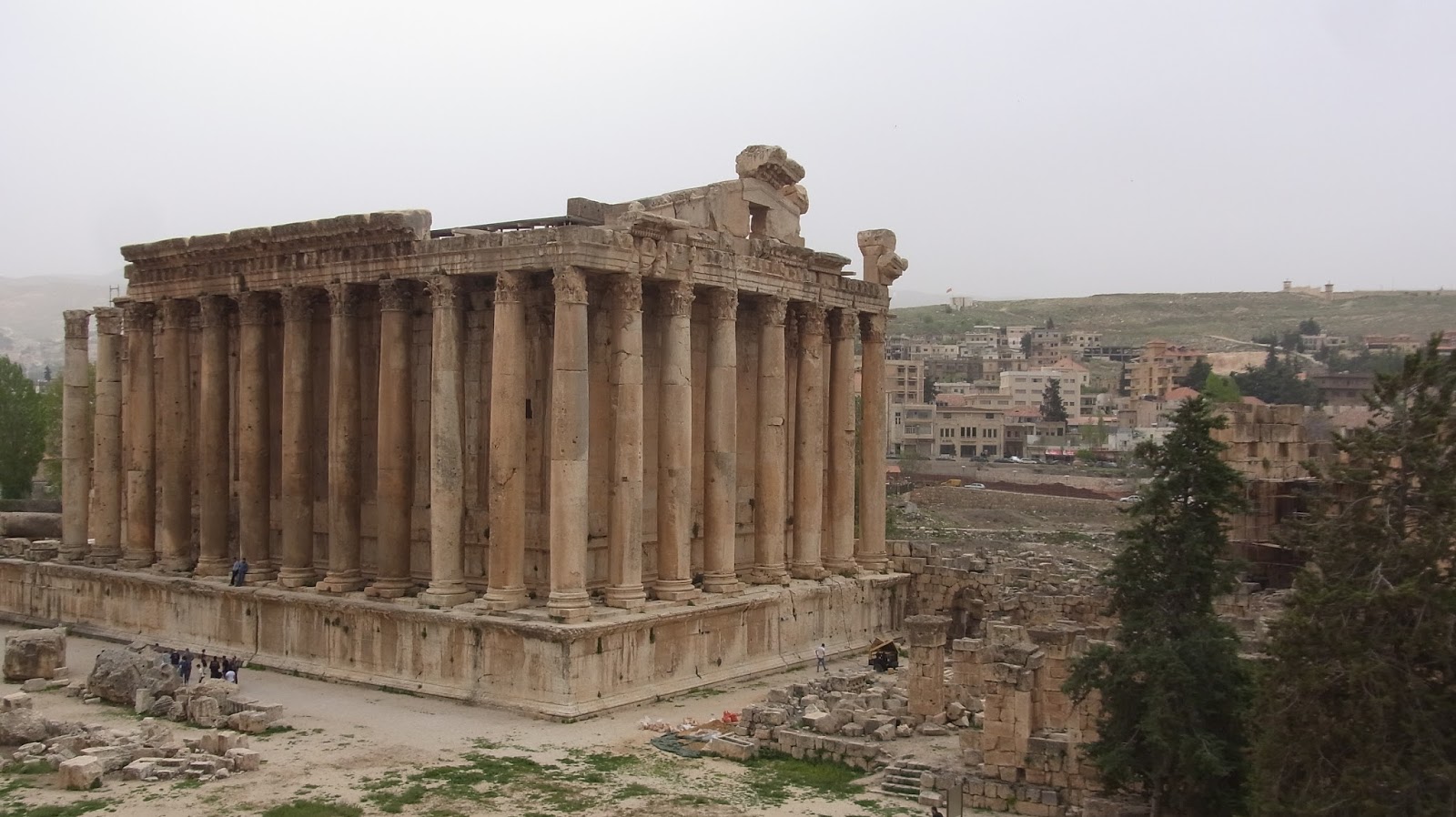
The Temple of Bacchus, above, believed to be the site of opium-fueled orgies, is bigger and better preserved than the Parthenon in Athens, embellished by reliefs of Bacchic figures and lions, which the Romans also found worthy of worship. 


Corinthian capitals on Temple of Bacchus
Horizontal ... Venus?
Sleeping lion: dozing since 150 A.D.


The temple complex at Baalbek provides many "pinch-me" moments. It's important that a replay of Palmyra not take place here, obviously. Three weeks ago as of this writing, the nihilistic hordes of ISIS were 30 miles away to the northeast in Ras Baalbek. May all the gods, pagan and otherwise, align to protect it.


Trinket salesman hawks yellow Hezbollah T-shirts for $5USD. No comment.


Tuesday, April 12, 2016

Tourists welcome

The first thing you notice is the politically ionized air. After passing through the bucolic countryside, pictures of militia leader Nasrallah and his deceased fighters line the highway. Bloody-knife imagery appears out of nowhere. 

This is the city of Baalbek, for decades a hotbed of a severe strain of Shia Islam, starting with the Iranian Revolutionary Guards who started preaching here in the early 1980s. Islamic Jihad, Islamic Amal and Hezbollah followed, each embracing martyrdom as a means of overthrowing Israeli and American interests in the region. 
Schoolkids in Baalbek


In all likelihood the suicide bombers who attacked the American Embassy in Beirut and the U.S. Marines barracks were trained here. It’s also where hostages Terry Anderson and Terry Waite were secreted during their years in captivity.
Saieda Khaoula mosque

Hezbollah doesn’t kidnap Westerners any more. I think it is reasonable to say that without Hezbollah, ISIS flags could one day be fluttering in Beirut. But I am resolved not to discuss politics while on the ground here and as a result, really don't have an opinion one way or the other. Maybe they just don’t like guys named Terry. 

The Party of God is a historical blip, as are we all. I am interested in what will endure. I am here to see Heliopolis, “The City of the Sun.”

Monday, April 11, 2016

Sassine Square in 1 minute


It's every man for himself at this 7-way intersection in east Beirut.

All too familiar with thunder

"What hath night to do with sleep?"
—Milton

Not much in this most resilient city. Tonight's sunset heralds a lightning storm, the weather girl says.

The ruins of Anjar

The early-Islam remnants at Anjar (The Flowing Spring) represent what’s left of an unusually large, sophisticated caravanserie along the incense/spice/silk road that passed through the Bekaa Valley. 


Built under the Umayyad Caliphate around 650 A.D., it was a place for road-weary merchants to recharge, take a bath, water their animals, buy provisions and catch a few z’s without fear of being robbed. All four of its gates were locked from the inside. Those deemed unsavory were kept out, and, in some cases, pelted with stones from atop the fortification's walls. A courthouse was here to settle disputes, and the castle's presiding Islamic steward kept a harem on the premises. Naturally.


Its sewage/drainage system still exists, and if you’re staring at your Twitter timeline, you could easily fall into it. Archaeologists say 600 shops were here. A handful have been reconstructed (badly, some contend), but the 1975-90 civil war got in the way, interrupting further work.


When I arrived there were a few random dudes standing around the gate. They inquired about my nationality. Apparently satisfied, they accepted $3USD and waved me through.


Inside the old settlement, a surveyor and his assistant, above, were taking measurements.

The small city had a short life. Caliph Ibrahim’s rival and successor, Marwan ben Mohammed, largely destroyed it in 740. This is what’s left.

It wasn't discovered by the outside world until shortly after World War II. Residents of the east-central Bekaa Valley, who no doubt had picnicked and clambered about on its stones, perhaps didn't think it worth mentioning. 


Sunday, April 10, 2016

Road to Damascus

Should I be stricken with a peculiar religious fanaticism rooted in the 7th century, I could walk 15 minutes to the Charles Helou bus station and catch a ride to the Islamic State capital of Raqqa, Syria. People (well, Syrians provisionally stuck in Beirut) do it all the time. 

Instead I get aboard a minibus on the road to Damascus a) because I can and b) there’s a good deal of history to be seen out that way. The prevailing thinking in Beirut in mid-April 2016 is that traveling to the Syrian capital is relatively safe, but I don’t necessarily share that confidence and will stop 3 miles short of the frontier to see the 8th-century ruins at Anjar.

The Beirut-Damascus road generally follows the path of the old railway that used to connect the two cities. It ascends in a series of switchbacks to about 7,000 feet above sea level before dipping sharply into the Bekaa Valley. I thought I would share a few unremarkable photos of this journey, and Joe’s Market in Aley seems as good a place as any to begin.

I am informed that this span was destroyed by Israeli jets in 2006. A little research shows the United States pitched in $20 million for its reconstruction.


Gas stop.


The road appears to crest around Bhamdoun.


I really like this shot (above) for some reason.


Miles and miles of vineyards, interspersed with farmers markets, cover the valley floor. It's like frickin' Napa. Most governments list the Bekaa as a no-go zone, which is understandable because they can’t possibly account for daily fluctuations on the war front. The minibus companies, I am assured, call ahead each morning to ensure the coast is clear.


A stark welcome to the Bekaa Valley, Lebanon's bread- and, er, meatbasket.


Approaching the Armenian village of Anjar. I had never met an Armenian before I came to stay in the Beirut neighborhood where they’re concentrated. They’re geeky and craftsy, and they look out for me.

Young women work the fields here, while the men … hell, I don’t know, they stand around and gossip. I approve of this state of affairs and believe it will find a ready export market in my part of the world.

This spot is about 25 miles from Damascus and I'll go no further. More on the Anjar ruins in a bit.